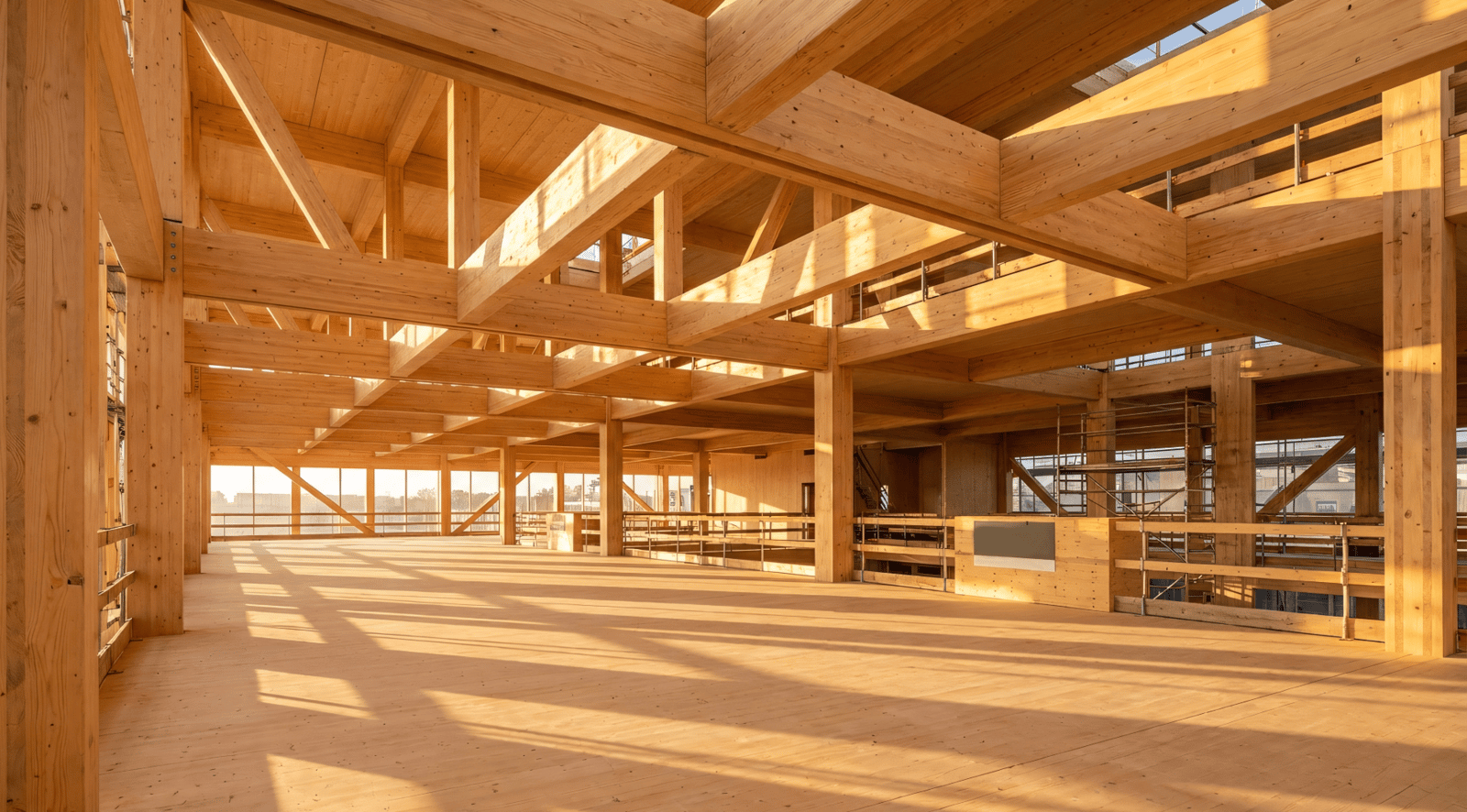
Mass timber in Canada: how engineered wood is becoming a scalable building solution
Risk ManagementArticleAugust 4, 2026
Mass timber is no longer just a design trend or sustainability play in Canada. It is starting to show up as a practical option for developers and builders under pressure to deliver faster, cost-competitive and lower-carbon projects. As adoption grows beyond a handful of showcase buildings, the question is becoming sharper: is mass timber ready to move from niche alternative to mainstream construction solution?
Mass timber is entering a different phase in Canada’s construction industry.
Not long ago, timber towers were viewed as ambitious architectural statements tied to sustainability goals or public sector experimentation. Today, the conversation is shifting. Developers, builders and institutional owners are increasingly looking at mass timber not as a niche environmental material, but as a practical construction strategy.
That shift comes at a time when the industry is facing pressure from every direction: labour shortages, rising material costs, tighter construction schedules, and growing demands to reduce carbon emissions. In that environment, mass timber is being evaluated less on novelty and more on performance.
And increasingly, the industry is paying attention.
According to Natural Resources Canada, there are more than 750 mass timber projects built or under construction across the country, representing nearly three million square metres of built space. What began as a series of demonstration projects is evolving into a broader market movement that could reshape how Canada builds housing, schools, offices and public infrastructure over the next decade.
“At this point, the industry has largely proven that mass timber works and is a technically viable solution,” says Annabelle Hamilton, Executive Director of WoodWorks BC. “The next stage is translating that potential into commonly accepted industry practices that support greater adoption by making mass timber repeatable, scalable and accessible across more building types and regions in Canada.”
The bigger question now is not whether mass timber works structurally. It is whether the market is ready to scale it.
Why mass timber construction is gaining momentum in Canada
Mass timber’s rise is often framed around climate change, and for good reason. Buildings account for a significant share of Canada’s greenhouse gas emissions, especially once embodied carbon, the emissions associated with building materials and construction, is included.
But on construction sites, the appeal of mass timber is becoming increasingly practical.
Engineered wood systems such as cross-laminated timber (CLT) and glulam allow large structural components to be manufactured off-site and assembled quickly on location. Entire structural systems, including floor and wall panels, can arrive ready for installation, reducing site congestion and shortening construction schedules.
For developers and contractors dealing with labour shortages and financing pressure, time has become one of the industry’s most valuable commodities.
On some projects, mass timber structures have the potential to reduce erection by 25% compared to conventional systems. Faster assembly can reduce carrying costs, improve schedule certainty and limit weather-related delays.
The economics are changing fast. So is the industry’s attitude toward timber.
“Mass timber is no longer just about bespoke or signature buildings,” says Hamilton. “The real opportunity is shifting adoption from the public sector into mainstream construction, where speed, prefabrication and cost-competitive solutions are becoming priorities.”
What is mass timber?
Despite growing awareness, mass timber is still widely misunderstood.
It is not conventional wood-frame construction scaled taller. Instead, mass timber refers to a family of engineered wood products created by bonding or fastening layers of wood together to form large structural panels and beams.
The most common systems include:
- Cross-laminated timber (CLT)
- Glue-laminated timber (glulam)
- Nail-laminated timber (NLT)
- Dowel-laminated timber (DLT)
These systems are designed to perform alongside steel and concrete, often as part of hybrid buildings that combine multiple materials based on structural requirements.
That hybrid approach is becoming more common in Canada, particularly in institutional and mixed-use developments where timber is paired with concrete cores or steel connections.
The future of mass timber construction is unlikely to be “all wood.” More realistically, it will involve using each material where it performs best.
Canada’s growing mass timber market
Canada is uniquely positioned to lead in mass timber construction.
British Columbia leads in North America, with more than 550 mass timber buildings completed or under construction, and the highest per-capita concentration of mass timber buildings on the continent. BC helped establish the early blueprint through wood-first procurement policies, a strong forestry sector and an experienced design community. Quebec has also emerged as a major player, combining manufacturing capacity with ambitious institutional and commercial projects. Ontario, meanwhile, is becoming a major centre of demand as urban development and institutional construction accelerate.
“In the Ontario market, the frequency of mass timber projects has been growing exponentially. What began as a handful of projects per year 20 years ago has grown to over 300 projects currently in active planning or under construction,” says Hailey Quiquero of WoodWorks Ontario. “By our bullish estimations, if Ontario is able to scale tall timber housing and associated community infrastructure, the market opportunity in the province for mass timber could reach up to 10% of new construction.”
Projects such as Vienna House, The Hive and Limberlost Place have helped push mass timber into the national spotlight. But the larger story is what is happening beyond headline projects.
Across Canada, timber systems are now being considered for multi-family residential buildings, schools, recreation centres and community infrastructure. In northern and remote regions, prefabricated timber assemblies are attracting attention because they can reduce on-site construction demands and compress schedules during short seasonal windows.
This is no longer a regional experiment. It is becoming a national construction discussion.
Why embodied carbon is changing building material decisions
One of the biggest forces accelerating mass timber adoption is the growing focus on embodied carbon.
Historically, building sustainability discussions focused on operational emissions such as heating and cooling. But as building systems become more energy efficient, emissions associated with materials themselves are receiving greater scrutiny.
Concrete and steel remain foundational construction materials, but both carry significant carbon impacts during manufacturing.
Mass timber offers developers another pathway. It typically has lower embodied carbon than conventional materials and stores carbon absorbed during tree growth throughout the product lifecycle. These attributes can support a broader low-carbon building strategy.
Municipal governments, institutional owners and ESG-focused investors are increasingly incorporating embodied carbon targets into procurement and development frameworks.
For developers, that introduces a new strategic calculation. Material selection is no longer only about cost and structural performance. Carbon accounting is beginning to influence financing, approvals and long-term asset positioning.
Fire performance and insurance concerns around mass timber
No issue generates more discussion around mass timber than fire performance.
Part of the challenge is perception. Many people still associate timber buildings with combustible light wood-frame construction rather than engineered structural systems designed for larger-scale buildings.
Mass timber behaves differently under fire conditions than many expect. Large timber members char on the outside when exposed to heat, creating a protective layer that helps preserve structural integrity.
That performance has informed years of Canadian fire testing and code development. Still, discussions increasingly extend beyond structural science into insurance and risk management.
Construction-phase exposure, moisture intrusion and limited historical loss data remain active concerns for insurers and lenders evaluating projects.
“That is where the next phase of adoption will likely be won or lost,” says Charbel Bou Farah, VP, Specialties and Retail at Zurich Resilience Solutions Canada. “The question today is less whether these buildings can perform, and more whether project teams are managing the risks early enough in the process.”
Mass timber does not eliminate construction risk. It changes where that risk sits.
Prefabrication shifts many critical decisions earlier into the design and coordination phase. Manufacturing tolerances, logistics planning and moisture protection become essential long before materials arrive on site.
“With mass timber, many of the critical risks sit earlier in the project lifecycle, particularly around coordination, moisture management and logistics,” Bou Farah says. “Projects that address those issues upfront tend to perform much better during delivery.”
The future of mass timber construction in Canada
The most interesting thing about mass timber may be that its future is no longer being driven by one single argument.
It is not only about sustainability. It is also about productivity, prefabrication, labour efficiency, industrial innovation, and supporting the domestic economy.
The Mass Timber Roadmap projects Canada’s domestic and export market could reach approximately $1.2 billion by 2030, supported by expanded manufacturing capacity and stronger supply chains.
But global competition is accelerating. Countries across Europe and Asia are investing heavily in timber manufacturing and low-carbon building systems. Canada’s advantage as a forest nation is real, but it is not guaranteed.
For developers, builders and general contractors, the takeaway is increasingly straightforward.
Mass timber is no longer a specialty material reserved for showcase projects. It is becoming part of a broader conversation about how Canada builds faster, lowers carbon impacts and modernises construction delivery.
The market is still evolving. Insurance familiarity, supply-chain consistency and code harmonisation continue to mature. But the direction is becoming harder to ignore.
In Canada, mass timber is moving from emerging alternative to scalable building solution.
Sources:
- Natural Resources Canada, State of Mass Timber in Canada
- Canada Green Building Council, national building emissions and embodied carbon data
- National Building Code of Canada 2025, encapsulated mass timber construction provisions
- Mass Timber Roadmap
- George Brown Polytechnic, Limberlost Place project information